
Product Launch
Introducing Argus Pulse: APC Data Processing and Ridership Reporting
February 2026
Argus Pulse is a cloud-hosted platform for processing automatic passenger counter data and producing NTD-compliant ridership reports for transit agencies.
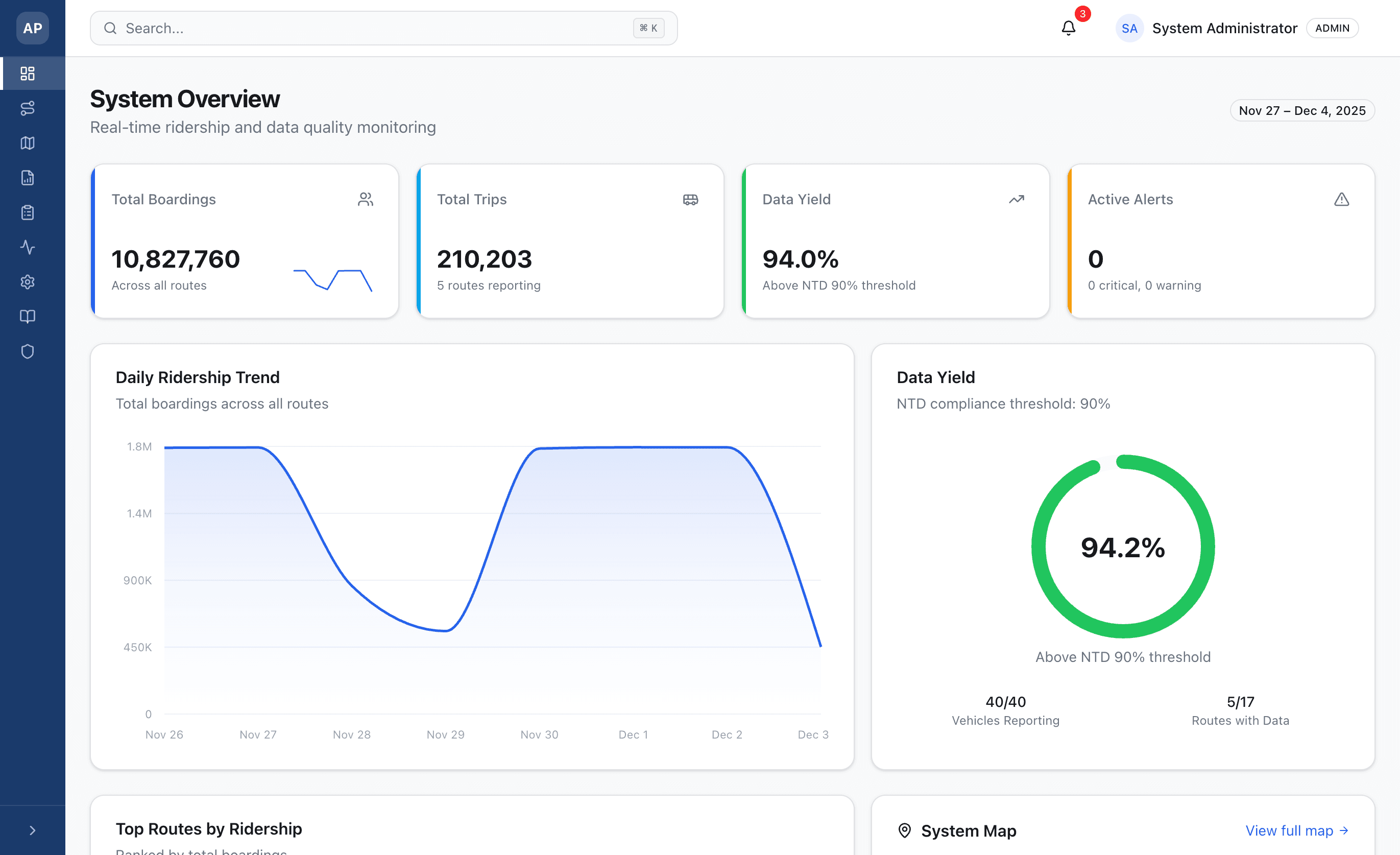
Transit agencies that operate automatic passenger counters collect millions of boarding and alighting records every month. This data arrives as raw sensor output — timestamped counts at individual doors across every vehicle in the fleet. Turning that raw data into validated ridership metrics, NTD-compliant reports, and actionable route analytics requires a processing pipeline that most agencies do not have.
The typical approach involves manual data exports, spreadsheet manipulation, ad-hoc validation checks, and weeks of analyst time to prepare each NTD submission. Route-level ridership patterns remain invisible because stop-level data is never systematically aggregated. Planning teams that need programmatic access to validated ridership data are left waiting for manual report generation.
What Argus Pulse Does
Argus Pulse automates the full pipeline from raw APC data ingestion through NTD-compliant report generation. The platform connects to APC systems from vendors like Clever Devices, Dilax, Eurotech, and Infodev via SFTP, ingests daily data feeds, matches trips against GTFS schedules, applies configurable validation rules, and produces the metrics that transit agencies need for federal reporting, route planning, and performance analysis.
The system is designed for three primary user types: transit analysts who explore ridership trends and prepare reports, system administrators who configure validation policies and manage data sources, and API consumers who integrate ridership data into external tools and planning systems.
Data Processing Pipeline
Argus Pulse ingests APC data through automated SFTP connections to APC vendors. Raw boarding and alighting counts are matched against GTFS schedule data to associate sensor readings with specific routes, trips, and stops. The matching process handles schedule deviations, vehicle substitutions, and partial trip data.
Once trips are matched, the data passes through the validation pipeline. Configurable rules check for zero-count trips, negative passenger loads, capacity exceedances, and boarding/alighting imbalances. Each rule has configurable thresholds and can be previewed before activation to understand its impact on downstream metrics.
NTD Reporting
The platform generates NTD-compliant metrics including Unlinked Passenger Trips (UPT), Passenger Miles Traveled (PMT), Revenue Miles, and Revenue Hours. These metrics are calculated from validated trip data with configurable factoring and sampling adjustments.
Agencies can trace any NTD number back to the source trips and validation rules that produced it. When factoring adjustments are applied, the system shows both raw and adjusted values with full calculation transparency.
Route Analytics
Argus Pulse provides route-level ridership analysis with interactive maps, stop-level boarding and alighting visualizations, and on-time performance distributions. Analysts can compare ridership across time periods, identify high-ridership stops, and track performance trends for individual routes or the full network.
The route explorer displays route geometry overlaid with ridership data, making it straightforward to identify patterns — which stops generate the most boardings, where load factors peak, and how ridership varies by time of day, day of week, or season.
Developer API
The platform exposes 24+ REST API endpoints covering routes, trips, stops, ridership metrics, NTD data, vehicles, schedules, and system configuration. All endpoints use OAuth2/JWT authentication and are documented through an interactive OpenAPI specification with code examples.
API access enables planning teams, BI tools, and external systems to pull validated ridership data programmatically rather than waiting for manual exports. Webhook support notifies downstream systems when new data is processed or when validation issues are detected.
Data Quality & Validation
The Policy & Validation Center gives administrators control over the rules that govern data quality. Validation rules are organized by category — zero-count detection, negative load checks, capacity exceedance, and custom agency-specific validations. Each rule change can be previewed before activation to see how many records would be affected.
Every policy change is versioned and timestamped, providing a complete audit trail. Administrators can roll back to previous configurations, compare the impact of different rule sets, and maintain documentation of why specific validation thresholds were chosen.
Learn more about Argus Pulse for your transit agency.